
Alert issued
12 daysA −1.6 °C frost forecast for July 14 in Caxias do Sul, identified 12 days in advance.
- Event
- Frost
- Forecast for
- Lead time
- 12 days
- Location
- Caxias do Sul/RS
Real portfolio of a credit cooperative in southern Brazil.
ESG and climate data infrastructure
Verifiable socio-environmental and climate risk data, by CNPJ, CPF and contract, for credit, insurance, compliance, supply chain and investment decisions.
EV-2026-09-30-0412
EV-2026-09-30-0413
EV-2026-09-30-0419
EV-2026-09-30-0420
EV-2026-09-30-0422
EV-2026-09-30-0423
EV-2026-09-30-0425
EV-2026-09-30-0426
EV-2026-09-30-0427
EV-2026-09-30-0430
ESGreen Score
799 of 1,000
By continuing, you complete your contact details. The pre-assessment is sent by an ESGreen expert.
Launch, FEBRABAN TECH 2026
Climate is already on the balance sheet. Now it needs to be in the decision. A Climate Risk Index from 0 to 100 that combines climate, ESG and operational data.
LIFT Papers 2026, Central Bank of Brazil and Fenasbac
Can ESG data be trusted? ESGreen's project published in LIFT Papers 2026, with the full paper available for download.
ESGreen Research
In the ESGreen database, about 48% of monitored companies have at least one active alert. See what this reveals about the supply chain.
Data as of Sep 2026. Source: ESGreen database.
Context
CMN and Central Bank resolutions, SUSEP rules and IFRS S2 call for a view of risk that goes beyond your own balance sheet and reaches the entire chain of counterparties.
Between one lookup and the next, blind spots appear.
From data to decision
The difference between saying you do it and being able to prove you do it.
Every CNPJ, CPF, land parcel and operation, tracked continuously.
Standardized information for committee, audit and regulator.
Every data point with source, date, version and evidence.
Evidence becomes action, and the action is recorded.
Decision feeds the next monitoring cycle
ESGreen provides data, evidence and an audit trail. Independent assurance and verification by accredited verifiers remain with auditors and verifiers.
Platform
From raw data to decision. Each layer feeds the next, and every result can be traced back to its source.
Public, regulatory and global sources, integrated and updated daily.
Models that turn data into measurable, comparable risk.
Risk built into credit, procurement, compliance and reporting routines.
Evidence becomes action, and the action is recorded.
At the institution
The third-party cycle
Before the contract, during the relationship and when something happens: every stage leaves evidence, and the decision is recorded.
Before the contract
On record ESGreen Score, risk level, each area's sign-off and the qualification report.
During the relationship
On record Alerts by type and by counterparty, certificates with history, lawsuits and news prioritized by risk.
When something happens
On record Area, owner, follow-up deadline, conversation with the supplier and supporting documents.
Decision
On record Final sign-off with decision, author and date.
Qualification tells you whether the supplier gets in. Monitoring tells you what changed. The Alert Center shows what your team did about it.
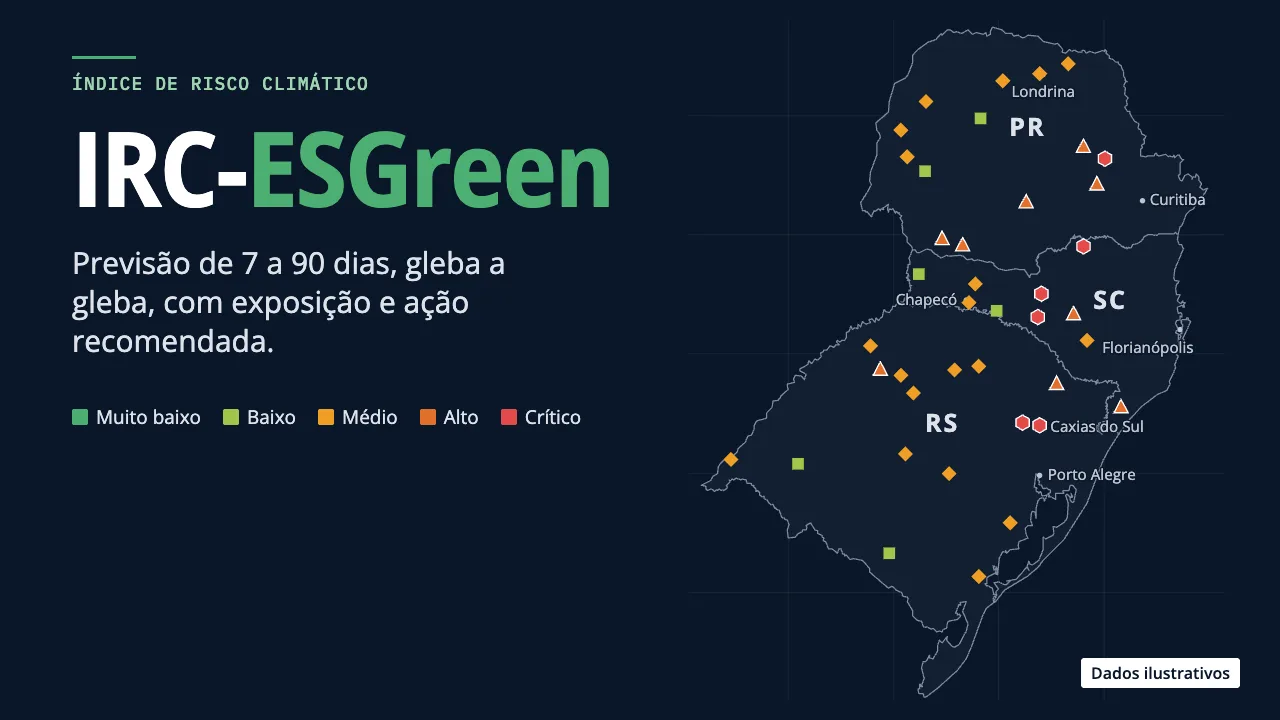
IRC-ESGreen, Climate Risk Index
The IRC-ESGreen measures physical climate risk by land parcel, contract and portfolio, converts exposure into reais and recommends an action for each operation.
Illustrative data: fictitious portfolio, does not represent real clients
Demo run DEMO-2026-09-30-A, fictitious data, issued on
The demo could not be loaded. Reload the page or contact ESGreen to see the IRC-ESGreen with an expert.
Illustrative map of the 40 fictitious land parcels. The most critical contracts are in the table below.
IRC band: the higher, the greater the risk
Each dot is a fictitious land parcel.
Horizon: 30 days
Portfolio average IRC
57 / 100
the higher, the greater the risk
Climate exposure
R$8.29M
estimated value at risk over the horizon
Contracts in the High or Critical band
15 of 40 (38%)
at least one land parcel with an IRC above 60
Predominant event
frost
most frequent among exposed land parcels
| # | Contract | Municipality/State | Crop | Forecast event | IRC | Band | Exposure | Suggested action |
|---|---|---|---|---|---|---|---|---|
| 1 | Fictitious contract 0020 G-020 | Videira/SC | grapes | frost | 94 | Critical | R$109K | block |
| 2 | Fictitious contract 0032 G-032 | Caxias do Sul/RS | grapes | frost | 87 | Critical | R$337K | provision |
| 3 | Fictitious contract 0010 G-010 | Castro/PR | beans | frost | 84 | Critical | R$190K | provision |
Ranked by IRC over the selected horizon. Ties are ranked by exposure in reais.
See the full demoThe problem isn't just that the climate is changing. It's the loss reaching the portfolio without warning.
Alert issued
12 daysA −1.6 °C frost forecast for July 14 in Caxias do Sul, identified 12 days in advance.
Real portfolio of a credit cooperative in southern Brazil.
Portfolio climate exposure over the analyzed horizon (example).
When you play it, the video loads from YouTube (youtube-nocookie.com) and Google may process browsing data. Cookie Policy
The video didn't load.
Watch on YouTube (opens in a new tab)The same infrastructure, configured for each institution's question.
Rural portfolio, members and suppliers monitored at system scale, with climate risk by land parcel and evidence for supervisors.
Socio-environmental and climate risk inside the credit workflow, with data for the new GRSAC tables and an evidence trail ready for CMN 5,185 reasonable assurance.
Underwrite with the climate ahead, not just the climate behind. CAR, embargo and slave labor list checks by CPF, CNPJ and property at underwriting.
ESG and climate data by issuer, asset and portfolio, for TSB classification, IFRS S2 reporting and the Previc ESG (ASG) plan.
Every company outsources part of its own risk. Qualification and continuous monitoring show what is in your chain today and alert you when something changes.
ESGreen Education
We train leaders, committees, boards and teams to integrate ESG into day-to-day decisions, from a one-off workshop to ongoing training.
Regulation
It's turning regulatory requirements into opportunities and portfolio management, with evidence and an audit trail.
Foreseen in an official document, with no date set in a rule yet.
Under consultation or with a proposed timeline. The direction is already set.
Rule published. The requirement takes effect in stages.
Already applies. Evidence must be kept up to date.
Informational content; not legal advice. Deadlines are set by regulators and subject to change; official dates are on the regulatory map. Status reviewed on .
In the Responsible Solutions chapter of the Sicredi 2025 Sustainability Report, prepared under the GRI standard, ESGreen is cited as the platform used to monitor and assess the ESG performance of Sicredi's suppliers.
“Today we have a customizable, agile platform that centralizes all the analysis of our supply chain, records every interaction with suppliers and generates a comparable ESG Score in minutes.”
Sicredi 2025 Sustainability Report, ch. 6 “Responsible Solutions”, p. 127 (GRI 2-6 | 3-3).
Read the Sicredi case study





Programs, hubs and events ESGreen takes part in. The presence of a brand does not imply endorsement by the institution.
Methodology
We publish how we assess.
Scale of 0 to 1,000: the higher, the lower the risk. 12 risk layers across 5 dimensions, published with a Confidence Index.
Higher = lower risk
Scale of 0 to 100: the higher, the greater the risk. IRC = Climate + ESG + Operational, in five bands, from Very low to Critical.
Higher = higher risk
70+ sources, with the date and origin of every piece of information, versioned methodology and dated runs.
Fictitious example, from the IBAMA source in the Evidence record at the top of the page.
The full methodology note is sent by email after you fill in the form.
Analyses, guides and case studies on regulation, climate risk, reporting and verification for companies and financial institutions.
Case studiesCase study
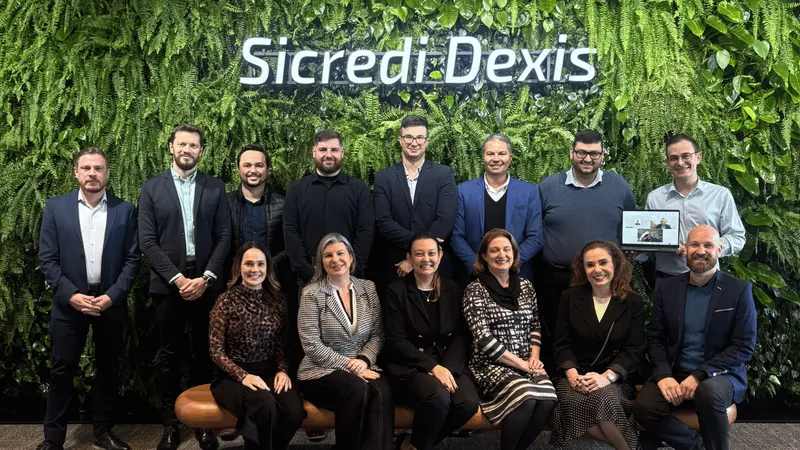
How ESG Lab, from ESGreen Education, prepared Sicredi Dexis managers to build the first local materiality matrix in the Sicredi System.
ESGreen in the media, announcements and events.
Book 30 minutes. We'll show you the infrastructure applied to your supply chain, your portfolio and your regulatory obligations.
Or write to contato@esgreen.com.br